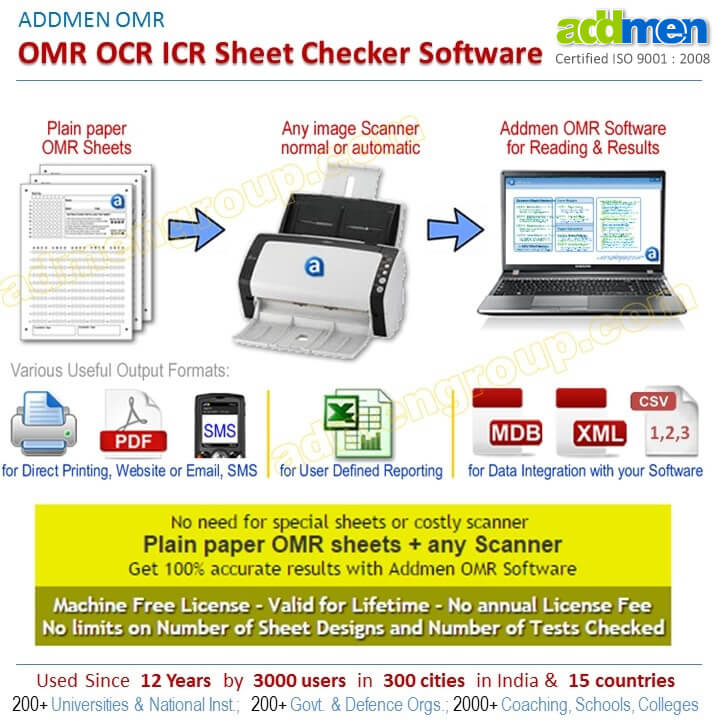
An OMR Optical Mark Reader is a technology used to identify and capture marked responses from specially designed forms and sheets. It plays a key role in automated data collection by converting physical marks into digital information with speed and accuracy. OMR Optical Mark Reader systems are widely used where large volumes of data need to be processed efficiently and reliably.
OMR Software Solutions are designed to read and process marked data from OMR sheets using Optical Mark Recognition technology. These solutions help organizations automate data capture, eliminate manual data entry, and improve accuracy.
OMR software is capable of recognizing different types of marks and structured response patterns, making it suitable for data collection, surveys, examinations, and other form-based applications. The software converts captured responses into digital formats for further analysis and reporting.
OMR Scanning Machines are used to scan filled OMR sheets and convert them into digital images for processing by OMR software. These machines enable fast and efficient handling of bulk OMR sheets and ensure consistent data capture quality.
OMR scanning machines work in coordination with OMR software solutions to deliver reliable results and support high-volume data processing requirements across various industries.
OCR technology is used to read and convert printed text into digital data. When integrated with OMR systems, OCR allows the capture of printed information present on OMR forms, such as numbers or text fields.
OCR enhances the functionality of OMR Optical Mark Reader systems by enabling the extraction of non-mark data alongside marked responses.
ICR is an advanced form of character recognition used to read handwritten text. In OMR Optical Mark Reader solutions, ICR enables the capture of handwritten information from designated fields on forms.
By combining OMR, OCR, and ICR technologies, Optical Mark Reader systems support comprehensive data capture from both marked and written inputs, improving flexibility and usability in real-world data collection scenarios.